Friday, January 06, 2017

How I Found Jesus With Steve Smith


Wide receiver Steve Smith retired from the NFL today. He'll end his career with 14,731 yards receiving and 83 touchdowns (plus 4 more on kickoff and punt returns), making him a lock for the Hall-of-Fame. But while fans will remember his exploits on the gridiron, I'll never forget the afternoon in late 2007, when he swaggered into the media room at Bank of America stadium, eating chicken wings from a Styrofoam container, looking damn annoyed to be sitting down with me for a one-on-one interview for an inspirational magazine.

I was still a relatively young reporter. Interviews were never my strong suit, they certainly weren't back then. So I was a bit nervous to speak with a guy known for often cursing out the press. Especially when the Panthers media representative warned me as we walked in, "Steve's not in the best mood today."

I told myself I had nothing to be nervous about. My publication featured true, inspirational stories--"puff pieces" in the industry parlance. I hadn't flown down from New York to Charlotte to ask any "gotcha" questions or make Steve look bad. I'd come to get Steve's story about how he'd matured-- from a rookie who had come into the league with a chip on his shoulder and sparred with teammates, into a respected team leader and all-pro. He'd previously spoken with the 700 Club, on the Christian Broadcasting Network, about his faith. My magazine wanted to know more about that.

Steve intimidated me from the start. Only 5'9" 185 pounds (I'm 6'0" and 200), he nonetheless seemed to tower over me. The guy was on my fantasy football team, and now I was actually meeting him. I tried warming him up with some small talk, some compliments. Then it occurred to me that he had better places to be on his day off. I got down to business. What was behind his transformation? What made him into a leader, a guy his teammates had voted team captain?

"I found Jesus," he told me. 

I waited for him to elaborate. He didn't. I needed a bit more than that to write a story. 

I tried a few different approaches. How did he find Jesus? Was there a specific moment that led him to believe? A mentor who introduced him to faith? After his rookie season, was there an experience he had which helped him re-evaluate what was important in his life? What came just before, just after? How did he change? "I found Jesus," he said, again.

I moved on, asked a few more questions, then circled back to ask him, "Steve, a lot of our readers would love to hear more about how you found Jesus.... what do you mean by that?"

He got angry. "I think we're done here," he said, glaring at me with a fierceness I thought he reserved only for opposing cornerbacks, pushing his chair away from the table with enough force that even the chicken bones in his Styrofoam tray quivered. I attempted to explain that I was just trying to get the details that would help readers understand his story.

"I can't explain it to you," he said. "Do you believe in Jesus?" 

On the interview tape, there are a few painful seconds of silence in which I internally debated telling Steve that I am, in fact, Jewish, though I respect the belief in Jesus as the Messiah and humbly admit I have no way of knowing the truth, though I went to a Methodist high school and sat in chapel every week listening to the choir and Reverend Murphy... But... I caught the Panthers media rep in the corner of my eye, staring at me, gently nodding yes.

"Yes, I believe in Jesus," I said.

Steve sat back down. We continued the interview for about 10 more minutes. He didn't give me much to go on, and my magazine never ran the story. It would have been published just about the time Steve punched his teammate Ken Lucas in the face.

Looking back, I can't say I blame Steve for stonewalling me. I didn't understand back then that the apparent contradictions in his story--his aggressiveness on the field and his strong faith--weren't contradictions at all. That the real story wasn't how he'd "matured," but how he'd reconciled those parts of himself.

The only way a 5'9" 185 pound guy can become a Hall-of-Famer in a league dominated by modern-day gladiators is to become fierceness personified. To play with unrelenting anger. Soften up for a minute out there, and you're done. But while Steve Smith clashed with teammates and the media, he found a way to keep that fierceness from bleeding too far outside the lines and destroying his life and career. 

Plenty of athletes claim to believe in God. But it's not just for appearances that Steve washes the feet of the homeless and has said that in retirement, he wants to continue his active role in a charity that provides footwear to those in need.

In his last game against the Cincinnati Bengals, Steve matched up against Pacman Jones and had a quiet day, 3 catches for 34 yards. The two have tussled for years on the field, fighting over every yard. But outside the lines, they couldn't be further apart. Two days after the game, Pacman would assault a police officer and spit on a nurse, most likely blowing his fifteenth chance in the NFL, after previously beating several women and shooting a man who became paralyzed for life. 

Steve, meanwhile, seeks a more humble existence. "Can I play another year?’ I probably could, but what I lose, I’m not willing to risk," Steve told the media after the game. "You know playing this game and expectations that are expected from you, it’s a lot of pressure... The pressure that I’ll have now is getting the kids to school on time, do I eat a pint of ice cream or a gallon of ice cream?"

Now that sounds like someone who found Jesus. Even if he never wants to quite explain how.


Wednesday, December 21, 2016

Did a Movie Exec Ruin Passengers?


I really wanted to see the movie Passengers, about two hibernating passengers on a spaceship headed to another planet, who wake up 90 years too early and face life and mortality aboard an otherwise person-less vessel--a vessel that may be breaking down. I'm a sci-fi buff, and the script has generated buzz for years before finally making it to the big screen this December, with likable leads Chris Pratt and Jennifer Lawrence. The writer, Jon Spaihts, was regarded as such a rising star that he was immediately hired to work on the reboot of the Alien franchise and other high profile projects.


Then the reviews came out:
"The major creative players either didn’t realize that they were essentially making a feature-length ad for Stockholm syndrome, or... they didn’t really care. And with Tyldum so glibly dismissive of (or oblivious to) what on paper might have seemed like interesting moral questions, the script doesn’t matter that much anyway. What matters here is the film’s effect. And the effect of Passengers is to turn frothy sci-fi romance into an astonishingly retrograde statement on autonomy and consent, and to turn one of the most likable actors in Hollywood into a total fucking creep."
Wait what? Not knowing anything about the finer plot details, this of course fascinated me. I wanted to know more.

How was it that this highly prized sci-fi project could ignore the fact that-- SPOILER ALERT -- when Pratt's character, Jim, sabotages the pod of Lawrence's character, Aurora (so he won't have to live out his days on the ship alone)  he's essentially committing a mixture of murder and rape? After all, according to the plot points I read... he essentially lies about why she woke up, and gets her into bed. What's worse--at the end, Jim and Aurora get over their "rape-cute" and fall in love.

Intrigued at how the script attempted to justify this (and how studio execs could let it slide) I sought out the script online, And I found not the movie that made it into theaters, but John Spaihts actual original script, which you can read here, at least until someone takes it down.

The general plot is the same--but the film's final third, which follows Jim's self-centered act, differs in significant ways. Ways that I believe made Spaihts script superior (but still flawed) to the movie version.

Don't read on if you want to read the script for yourself first. SPOILERS ahead.

The biggest difference is pretty big. And you can see why a studio exec might have wanted to cut it. But in a way, it's the only ethical route out of the sin Jim's committed. And taking it out alters the movie in a fundamental way.

The difference is this: In the end, all the passengers aboard the ship--with the exception of Jim and Aurora-- are killed.

In the movie version, Jim fixes the reactor in a heroic act, saving everyone aboard, which redeems him in the eyes of Aurora, who decides that living aboard the ship for the rest of her life with the man who raped her is what she wants, because... love I guess?

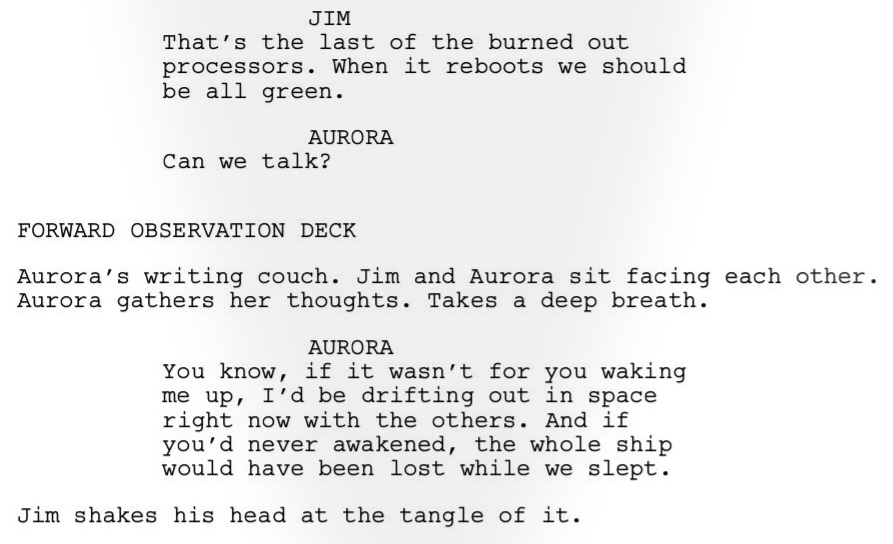
In the original script, however, Jim and Aurora fix the reactor together... and then the system reboots. When it reboots, something terrible happens:

Or, at least the computer thinks the pods are empty.

It's a moment that suddenly casts everything before it in a new light. The villain of the movie, alluded to at varying times earlier in the film, is the large, soulless corporation that built this "asteroid-proof" spaceship and seemingly cut corners to maximize profits. Jim's earlier griping about the world no longer needing engineers like him... well, this shows the implications. No one thought through the dangers, and thousands of people in an instant are jettisoned into space, despite Jim and Aurora's frantic efforts to save them (there's a harrowing scene of the ship's captain, waking up a moment before he's shot out to his death).

Jim's rape-y act kind of starts to pale in comparison to the negligence and greed that just murdered thousands of people. 

Lest you think the movie leaves us on this horrifying note, there are still a few minutes to go. And that running time establishes Jim and Aurora as something quite different than they were before. Now they truly are alone. But they don't want their lives to end. They don't want their time remaining to be in vain. 


Now at least, you can see a valid reason why Aurora might dismiss what happened earlier. The two form a new kind of partnership. If before was simply lust and romance, now it's parenthood. It's guardianship.

The script establishes earlier that on-board the ship, there is a storage facility with the genetic material of every passenger. For the rest of their lives, Aurora and Jim use this genetic material to bring to life the children (or clones, I guess) of everyone who was lost in the tragedy. Aurora uses her writing chops to pen a book about the massacre and building a livable world on the ship. With this context, Aurora's decision to forgive Jim, and their ensuing romance, becomes, in a "tangled" way, at least justifiable. The characters have motivations that transcend shallow romance. The world they create aboard isn't for them-- it's for those who died, and the generation raised in their honor. At worst, it's their way to survive.

Now, you can think this ending is just as bad--some studio exec certainly did. But it's certainly less of a Stockholm-syndrome story/Bro-fantasy and more in the vein of other sci-fi epics which address the coldness and cruelties of corporations and delve into morally complex issues.

I wonder what Jon Spaihts thinks about the changes. In the meantime, I guess I'll wait for the film to come out on Netflix.

Monday, December 05, 2016

Will Pizzagate Destroy Reality?


In 2009, the Cartoon Network show "South Park," skewered the "political commentary" style of Fox News luminaries like Glenn Beck, who sometimes made outrageous accusations with no basis in fact, couched in their defense, "I'm just asking questions." The character Cartman accuses student council president Wendy Testaburger of, among other things, committing genocide against Smurfs. Several students, believing that the questions wouldn't have been asked if there wasn't truth to the allegations, form a mob and demand Wendy face justice.

It seems like a ridiculous scenario, the kind of thing that can only happen in the cartoon world. But in the real world, a bunch of people have started the same behavior--"just asking questions"-- and it's already causing real world violence.

Is Hillary Clinton covering up a worldwide pedophile ring? Is the Clinton Foundation cover for an international pedophile syndicate? "I'm just asking questions." To a lot of people, these questions sound ridiculous. But to a growing number of self-professed sleuths gathering on internet message boards, these are questions worth investigating... and the more questions they ask, the deeper down the rabbit hole they go.

If you want a taste--and believe me, you don't--check this nutbar fever dream out.

It boils down to this. First, some white supremacist on Twitter made up a story about Anthony Weiner's emails revealing a Clinton pedophile ring. Then, among the thousands of embarrassing emails uncovered by Wikileaks in the days leading up to Donald Trump's election, there were a few in Clinton adviser John Podesta's gmail account that referred to pizza. For example:
John -- Hosting pizza party at Belmont for HFA on April 10. Maya Harris is joining, but need you. Can you come? Thanks much, Tony
Now, this looks totally innocent, to some people. The people who don't ask questions. But some of the other pizza emails seemed strange to people who have never left their basements or had a social life. A bunch of staffers joking about how to split up the last slice from an office party. An email from a realtor asking if John had left a handkerchief with a "map that seems pizza-related" on the kitchen island at a rental property. Just look up the word "pizza" in Wikileaks and you'll find 149 results. Is it possible that these emails were all just about pizza?

Yes, but no. Because, get ready for this... the site 4chan proposed that some of the words in these emails are actually code words. The source for these code words is.... well, unknown, but this 4chan user figured it out. By plugging in the code words for innocuous words like "pizza," it turns out that Podesta, the realtor, a dozen staffers, a pizza parlor owner and everyone else in the emails were actually talking about the cutie underage minors they were going to kidnap, torture and rape.

If this seems like a stretch to you, these good-hearted internet citizens would tell you that you're not asking enough questions.

Snopes did a pretty thorough teardown  of why the "evidence" uncovered is most certainly bullshit, but all the debunking has done nothing to dissuade people from threatening the owner of a pizza parlor in D.C. and neighboring businesses.

Lest you think this is just fun and games, yesterday, a man with a gun walked into that same pizza parlor and fired a shot.

But of course, if your one who "asks questions," then you're already suspicious of the timing. What a coincidence that just when people are starting to believe pizzagate, a guy walks in with a gun?

Well, what if the gunman was just a "crisis actor?" HE HAS AN IMDB PAGE!!!!!

You can see a pattern in anything. If you look hard enough, everything is a conspiracy. Just because some things look alike or some people know each other or some places exist side by side doesn't mean they have a nefarious connection.

I believe in facts. Not speculation based on what art someone owns or whose party someone's brother once attended. Find a victim, find a crime scene, find forensic evidence, find one iota of proof that isn't an attack on someone's character or something you found that originated on 4chan. Nothing here would stand up in a court of law... that should tell you something.

These are real people that are being accused of gruesome, terrible things. They're not abstract cartoon characters. John Podesta, Hillary Clinton, the pizza guy, etc. You may not like their politics. You may not like them personally. But an accusation of pedophilia is pretty heavy. An accusation of running child trafficking is even heavier. That's pretty big weight to be throwing at someone based off of conjecture. Even an accusation is something that sticks with someone. You put it out there, you give it a semblance of validity, you might convince someone, not just that you're "asking questions," but that it's true. And that has consequences. False accusations can have real life negative effects. Especially something like this that gets people rightly fired up. You want to encourage some righteous wannabe hero to engage in some vigilante justice? Intelligent people don't make charges without real solid evidence. Find it, tell the world! But engaging in witch hunts based on circumstantial (to be generous) evidence, guilt by association tactics, and pure speculation doesn't help anyone. It hurts people.

That's my view. But it isn't the view shared by those whipping up pizzagate hysteria, the "just asking questions" crowd. Unfortunately, it seems to be spreading like a sickness. Now this same crowd is saying that the fake news sites that proliferated this election cycle weren't fake at all.

How many people who voted for Donald Trump did it because they believe Hillary Clinton runs a pedophile ring? You can laugh that off, but you can't laugh off the fact that there were millions of people who thought that there was something about her emails that made her more untrustworthy than a man involved in a fraud lawsuit he would later settle for $25 million dollars.

We're taught to question what people tell us. That's a good thing. But when the truth itself becomes a question, when there's no such thing as "fact," only the level of "digging" you've done online, reality itself becomes distorted. It's one thing to question the bias of the media.... its another thing to claim all media is in on one big conspiracy to protect a pedophile ring. Again, the media is not a bogeyman, it's made of individuals, many of whom actually have children they'd be interested in protecting.

Consider this... if the Clintons were running a pedophile ring, wouldn't some media outlet want that story? The Boston Globe won a Pulitzer for outing the Catholic Church for protecting abusive priests. Wouldn't there be some intrepid reporter going undercover, finding that dungeon below the pizza parlor?

I'm just asking questions.

Friday, November 11, 2016

We The People Still Have The Power


Not a great start for President-elect Trump, attacking freedom of speech, freedom of assembly, and freedom of the press in less than 140 characters.

Fascist tweets aside, I'm willing to keep an open mind about a Trump Presidency (call this the "acceptance" stage of grief). Right now, all we have is the fear-- we have yet to see how he and the disturbing people he's surrounded himself with will put their chilling rhetoric into action. It's hard to imagine--given everything Trump has said (or Tweeted) and done--how he will suddenly become an enlightened leader. Even half of his supporters aren't expecting great things here (the non-deplorables). But it is possible that with an organized opposition, any damage he can do to this country will be limited.

In the past few days, millions of Americans have mobilized in cities around the U.S. as a show of force. There are 59.9 million people who voted against Trump--a slim majority of American voters-- and what these protests show is that we're not going to be silent and we're not going to be steamrolled.

This is not a repudiation of those who voted for Trump. Sure, some in the crowd may demand the election be overturned, but that's not realistic, nor is it the point of these mass demonstrations. These protests are meant to serve as a warning. In our lifetimes, we've seen rapid social progress for the rights of minorities, women and LGBT citizens, advances in world peace, environmental health, and economic prosperity-- if Trump rolls back any of the rights or protections we've fought so hard for, these protests make it clear that he and the whole country will hear about it.

Even Wall Street sent a strong signal to Trump in the late hours of Election Day. Dow futures plummeted, before the market returned in the morning to make gains. It's hard not to see that blip as a threat from Wall Street-- screw up this economy, and these are the charts America will be looking at come next election.

We cannot forget that we have a government that answers to its people at all times. Not just on election days. Civil disobedience and protest have a long history in this country-- from the Boston Tea Party to Rosa Parks to Woodstock. Americans stood up for what they believed in against the powers that stood against them, and by show of solidarity and by virtue of their righteousness, won. This is the story of America. It's not anti-democratic to protest... it's in our blood.

Now is not the time to curl up in a ball and cry (though, that's an understandable emotion). Now is the time to get involved. For too many years, too many of us have been Facebook activists. We've forgotten what it means to hit the streets, to shout, to stand and be seen. To get involved.

This is a call to action.

Trump may be our next President, but he will not be our Dictator. When he threatens our liberties, we cannot, and will not, take it lying down.

Pay attention to what Trump does next. If he appoints a white nationalist anti-Semite as his chief of staff. If he allows Mike Pence and his ilk to pass discrimination laws against gay Americans or restrictions on women's health. Watch and see if he takes health care away from millions, while replacing it with nothing. Take notice if he endangers our security by pulling out of alliances and international treaties, or if he rattles the nuclear saber and risks war. All of us need to hold him accountable for his actions-- and not just those who didn't vote for him, but those who did. If he hurts us, don't stay silent.

Let us always remember the words of the infamous Access Hollywood tape. Not the "grab them by the pussy" part. The part that reveals what kind of man Trump is and how he may govern:
"And when you’re a star, they let you do it. You can do anything."
It's up to we, the people, over the next 4 years, to make sure he can't.

Wednesday, November 09, 2016

Hillary Was Who They Said She Was


Like 50,000,000+ other Americans, I am shocked and dismayed, and greatly fear the future. That's never happened after an election in my lifetime. When Bush defeated Kerry in 2004, I thought plenty of people were nuts. But I didn't fear for my country that way I do now. Maybe Trump will prove us all wrong. Maybe he won't run the country the way he ran his businesses, bankrupting them while enriching himself, maybe all the racist and sexist talk and behavior was only hot air aimed at making a billionaire more relatable to the common man, maybe...

But we all know who Trump is. We've been saying it all along. The surprise is finding out who Hillary really was.

Last night, Hillary supporters gathered in the Javits center were crying and stunned by the bad, unthinkable news that kept rolling in. They'd come expecting victory, instead, they faced their worst nightmare. Whether you believe the dire apocalyptic scenarios put forward by many political writers or not, there's no denying that at a certain point in the evening, for Hillary supporters, it felt like the end of the world.

And at that moment, she sent John Podesta to speak to the crowd, and tell them to go home.

Which would have been fine... I guess... If she and her campaign really were going to wait until every last vote was counted. Kerry, in 2004, waited until the next day too. Of course, we know what happened in 2000 as well.

But a heartbeat later, before the Javits center could even fully clear out, Hillary conceded to Trump in a private phone call. She didn't speak to her supporters. She didn't speak to a worried, fractured nation or a frightened world. She went to bed.

Bernie supporters tried to warn us from the beginning. They claimed she'd lost touch with the people, that she didn't feel our pain. The Bernie Bros that I dismissed as deluded about their candidate's electoral chances were right. This election came down to who was more passionate about the country, who cared about fixing its problems. Hillary, to be charitable, played it safe, choosing a message that to stay the course, with slight corrections, was the more prudent way forward. I still believe she was right... But that doesn't matter. The message was all wrong--it failed to connect with the people she needed to win. As it turned out, her temperament, calm, above-the-fray, unmoved... was the problem.

It had nothing to do with the emails.

And at our darkest hour, Hillary proved her critics right. She took thousands from the likes of Goldman Sachs to give inspirational speeches, but the speech she needed to give, one she'd been paid millions for by the American people, she refused.

John Podesta... John friggin Podesta... told us to go to bed instead.

Hillary abandoned us, abandoned the party, abandoned the country at a time when we needed her to say everything would be okay, that progressive ideals aren't dead, that the fight will go on, renewed and reinvigorated. She needed to tell us this is day one of building New Democratic engines in our communities, so that a million young, engaged, and idealistic Bernie Sanders, Elizabeth Warrens, and Hillary Clintons emerge to save this country from its worst impulses.

Maybe we should have paid her more.

Losing last night was a tragedy--the extent of it is yet to be seen. It could have been redeemed somewhat by a triumphant call to return to the principles that made our country the shining city on a hill, the beacon of light and freedom to the world.

Hillary was silent. I hope and pray we don't follow her example.

Visitor Map: