Monday, December 02, 2013

Um... Chanukah?

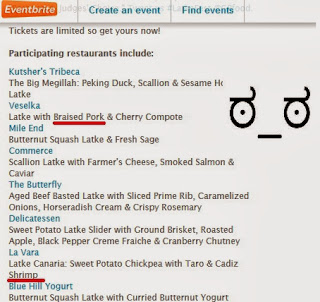
There's a potato latke festival going on tonight in Chelsea in honor of Chanukah, and some of the city's best restaurants will be participating. In order to attend, you'll have to lay out some serious gelt: the cheapest tickets are $55.

That said, hold onto your dreidels, because something is amiss...

http://www.eventbrite.com/e/5th-annual-latke-festival-tickets-8502219367
That ain't kosher.
 Braised Pork!?!? Shrimp!?!?! This is worse than the Chanukah ham:

http://www.snopes.com/photos/signs/hanukkah.asp
No, not delicious for Chanukah
Seriously, the Fifth Annual Latke Festival??? You should have gotten your act together by now. We're really going goy for a festival celebrating Jewish tradition? At least go kosher-style.

This is what happens when the Ukranians and the Mexicans attempt to create Jewish food. (although Toloache and Yerba Buena chef Julian Medina gets it right)

Somewhere, an old Jewish man is rolling in his grave, and complaining.

Wednesday, November 27, 2013

Down The Rabbit Hole With Kleargear.com

A bizarre story hit the news this week, just in time for the holiday shopping season. A couple has been fined $3,500 and had their credit destroyed for leaving a bad review about the website Kleargear.com, a marketplace claiming to sell funky gadgets.
KlearGear.com didn't deliver Palmer's online order of a desk ornament that was less than $20, so it cancelled the transaction in Dec. 2008. Jen Palmer, now 40, wrote a negative review on private business review site RipoffReport.com, saying KlearGear.com had "horrible customer service practices."
"Once we put the review up we pretty much forgot about it." Then last summer, her husband, John, a senior network engineer, received an email from KlearGear.com demanding $3,500 pursuant to a non-disparagement clause that it claimed was in its "Terms of Use" on its website. "We were blown away," Jen Palmer said...
Allegedly, the company contacted credit bureaus about the $3,500 debt, and that helped destroy the Palmers lives.
 The Palmers said the mark on their credit history affects their ability to obtain loans, most recently for a financing plan for a new furnace. As a result, last month the couple and their 3-year-old son were without heat for three weeks until they saved the $1,900 to buy a furnace.
"Utah in October gets very cold pretty quickly," Jen Palmer said.
The whole story makes little sense. If Kleargear is trying to prevent negative reviews from damaging their reputation... hounding a family into the poor house is not exactly helping matters. The negative PR from this debacle greatly outweighs one negative online review.

But oh man, if you think that's where the story ends, you've got another thing coming...

Internet sleuths quickly got to work unraveling the mystery behind the site's shady owners. And I mean shady. You'd think that a business claiming to make tens of millions of dollars a year wouldn't hide their CEO, their physical location, and their employees... but you'd be wrong.

Lee Gersten, the president of Kleargear? There's no trace that he actually exists. The address of the company is a mail forwarding service. Even the "parent company" is nothing more than an address offering "virtual office space" in France, to companies located elsewhere. Ken White and his friends at Popehat dug deeper:
Here are the problems with KlearGear's display of the TRUSTe certified privacy seal:
1. A source within TRUSTe informs me that genuine seals are clickable links leading to a certification page; this is just an image on KlearGear's page.
2. KlearGear is not in TRUSTe's searchable database of certified sites.
3. My source within TRUSTe confirms that KlearGear.com has never been TRUSTe certified.
Actually, they determined that most, if not all of the dozens of certification and verification badges displayed on the site are fake:
As of November 28, 2012, the BBB discovered that some pages of the company's website display the BBB Accredited Business Logo and state "BBB Rating A+", when neither is true.
The BBB contacted the company at the Michigan mail drop address instructing the company to immediately remove the incorrect BBB logo and reference from their site.
This matter is currently pending.
In fact, some of the seals are completely bogus:
An image search [for] the 5 Star eTAILER Ratings shows that the only place using that seal is KLEARGEAR.
Even the letter to the Palmers demanding payment for the fine is bogus!
One of the collection agents of the purported Kleargear "legal department" signs himself Stephen Gutman, of Fishman group attorneys... He is listed with the Michigan bar here:
http://www.michbar.org/memberdirectory/detail.cfm?PID=14480
He's the only Stephen L. Gutman licensed to practice law in Michigan. The contact information on the letter is that of the "The Fishman Group" however, though it does not match his bar info.
And, there's the fact that he's probably retired and in no way involved:
 The Stephen L. Gutman practicing in Michigan was licensed in 1967, and is likely to be [a] 70 yo gentleman.
You can try contacting the PR department at Kleargear, but don't expect to reach  Margaux Banet, the listed PR agent. She simply does not exist. None of the other names associated with the site appear to be real either, although the head of the parent company is also the name listed on a website for a collections agency... an agency that doesn't seem to actually exist.

Has anyone EVER received a product from Kleargear? From what I can tell, the only evidence the company exists at all is their website and dozens of press releases sent out under that name. News and blog sites have featured products from the company... but it seems like all their copy, photos, even quotes from the people involved, all come from these press releases.

Here's the $3,500 question: What is going on? If this is, and always has been, a fake eCommerce site, with the sole purpose of grifting customers out of money, then it makes sense they would send an email to the Palmers demanding more money. But contacting the credit bureaus? That seems to go beyond the normal scam.

Is it possible that this is the scammer's M.O? They use a fake lawyer from a fake collections agency to contact the credit bureaus, and suddenly, the fake debt becomes real. The credit bureaus are enlisted in putting pressure on the scam victim, and the scammer increases his odds of getting paid.

According to Experian, part of the approval process to be able to report debts to the agency includes a "physical inspection where a 3rd party must come to your location and perform an inspection for security purposes." So before Experian could take the Palmers' debt seriously, they'd have to have a report from a 3rd party affirming Kleargear.com actually existed. In addition, there are a lot of registration requirements which would seem to deter any scammer who didn't want to leave a paper trail. But what if the scammer behind Kleargear found some loophole? A way to trick the system into accepting false collections claims?

Anyone know if this would be a possibility? Are the credit bureaus that easy to hoodwink?

This is going to somehow lead back to Nigeria. I just know it.

Monday, October 28, 2013

D in Dallas Does Not Stand For Discipline

As a fan of the New York Football Giants, I couldn't be happier to see Dallas Cowboys lose. Especially in such a painful way.

I can't imagine how, with the ball 6 inches away from the goal line, how the Dallas defense could just stand up and not bother attacking, even with the Lions' QB Stafford feverishly giving the "spike ball" signal. The ball is 6 inches away from the game-winning touchdown! Dig in! Defend!

But that sort of sums up why the Cowboys haven't won it all these past few years. For all the focus on Dez Bryant's sideline theatrics, the whole team seems to go nuts whenever anything is on the line. Mental errors, costly penalties... apply a little pressure and the team goes haywire. That's on the players, yes, but its also a failure of leadership. I'm looking at you, Jason Garrett.

Of course, as a Giants' fan, I'm all too used to watching haywire football this season. If only there was someone to blame for an out-of-sync offense that continually feeds Peyton Hillis with carries while far more talented players are on the field... *cough Kevin Gilbride *cough.

How to Lose Friends, Influence, and People

Remember the glory days of George W. Bush, when we were all up in arms about the Patriot Act and its assault on our rights to privacy? Seems quaint now. Privacy is officially an illusion these days, a truth revealed by Edward Snowden. And it's not just Americans that the United States is spying on, it's the whole world--including our closest allies.

Those revelations have understandably made the international community incredibly upset. Bugging Andrea Merkel's phone? Eavesdropping on 60 million Spanish citizens... in a month? Reading the President of Mexico's emails? This is how we treat our friends?

Imagine if your buddies found out you were spying on them. How would they suddenly regard you? No wonder the U.S. was so determined to get Snowden into custody... it's not that he was a traitor, it's that he knew that we had betrayed the trust of those we count on most in the international community. Now that the cat's out of the bag, the question is, will our relationship with our international friends be forever damaged?

You don't undo decades of history is a single swoop, but the relations we've shared with our allies through two world wars and a bevy of international conflicts were already strained by the arrogance of George W. Bush's administration. The revelation that the Obama administration did nothing to stop these surveillance programs from overreaching is a debacle that threatens international cooperation on a host of other issues. How can we expect the world to respect the freedom of individuals when our own government has shown itself to be a bunch of hypocrites?

How can we take China to task for its lockdown on free speech and its abuses of human rights, when our own government has gathered the personal, private information of millions of innocent people? How can we stand as a beacon of hope and freedom to the world when our government has shown a blatant disregard for individual privacy?

We can't defend this. Not on the grounds that we were only targeting terrorists. Leaks have revealed that to be untrue. If you're targeting terrorists, target terrorists. Don't collect millions of phone records and THEN decide who looks like a terrorist.

After 9/11, the international community rallied behind us. For the first time in human history, the majority of the world was on the same side in battle. A battle against international terrorism. These revelations have fractured that. They smack of Cold War-era mistrust. They isolate us from the rest of the world.

Obama claims he had no idea... which doesn't absolve him, and in fact, drops him a few more levels in my esteem. The buck stops with the President, period. For him to claim ignorance over a spying program of this scope and size is either unbelievable or frightening. He's either lying-- which in this case, is a best case scenario-- or he's admitting that our military intelligence complex, given broad powers in the wake of 9/11, has become some Orwellian nightmare... beholden to zero oversight, paranoid even around its friends, and wildly inefficient. Don't defend bugging our allies' phones and scooping up the communications of millions of people-- question whether those resources wouldn't be better spent on people and places we know to be trouble.

The NSA has so far failed to reveal any real intelligence coups these programs have made. The oft-repeated figure of 54 plots thwarted isn't accurate, given statements from those who have reviewed the classified material. More importantly, none of the phone calls or emails gathered by the NSA program from our allies' governments led to the discovery of any terror plots.

In the coming months, Obama has a lot of 'splainin to do. If the United States is to regain respect as an international leader, it must earn back trust. I'm not sure how you do that unless we restore oversight to the intelligence gathering process and repeal the parts of the Patriot Act which give our government the right to spy on people who have never been accused of a crime.

If we seek out the terrorists we know, we'll find the ones we don't. If we look at every innocent person, all we do is waste time, goodwill, and the cooperation of our friends. We're a strong, great nation-- but if we don't change our behavior, we'll end up alone.

Here's hoping wisdom prevails.

Wednesday, October 23, 2013

A Middle Ground For Gun Control: Gun Safety

A Nevada middle school is the latest tragic scene in a long line of school shootings. In Massachusetts, a 14 year-old is being sought for shooting a beloved teacher and disposing of her body behind in the woods. In Texas, a napping nanny left her gun lying around, and her 5-year-old charge accidentally killed himself with it.

In all these cases, the shooters who pulled the trigger didn't buy their weapons. They simply took them from someone who was careless enough to leave their guns easily accessible.

In the debate over gun control, 2nd-amendment advocates say we don't need more gun laws. They say that everything is working just fine. More gun laws will only punish law-abiding gun owners.

But here's the thing. With no laws mandating gun safety measures, a law-abiding citizen can easily leave their gun vulnerable to misuse by somebody else. Only after that gun is used in a tragedy can they be brought up on any charges. Perhaps if laws were in place that were proactive rather than reactive, those people would have kept their guns better secured.

There are many easy solutions. Easy to implement, that is. At least if the gun lobby actually wants to stop their favorite product from making headlines for killing kids.

1. Require gun locks. Gun advocates argue that gun locks are cumbersome in case of an emergency. Okay, maybe. But requiring gun locks on weapons doesn't stop a gun owner from keeping their weapon unlocked when it's attended to. Need the security of that gun in your nightstand when you're going to bed? Sure, leave the gun unlocked while you're right next to it with your bedroom door closed. But when you leave the house, when your kids are playing near by, when you're out running errands... you have a lock on your gun which makes sure nobody else can use it in your absence.

2. Require gun safety classes. Right now, anyone without a criminal record can purchase a weapon. Okay, great. But there are a ton of idiots out there who... well, will think nothing of leaving a gun lying out while a 5-year-old is around. Requiring a gun safety course before a weapon can be purchased won't weed out all the idiots, but it will do two things. One, it will establish a longer period of contact between a gun purchaser and another party-- possibly enough to raise red flags if it seems that gun purchaser may intend to harm someone. Two, it assures that a gun purchaser has at least been taught basic safety and use of the dangerous product they're buying. Not all of the safety issues surrounding guns are immediately obvious-- for instance, if you hold the gun incorrectly, you're likely to break your finger due to the bolt action/hammer engaging. Or you may just shoot yourself not realizing that there's a bullet in the chamber after removing the ammo clip.

3. Offer incentives to gun companies to add gun safety features. Gun manufacturers have plenty of incentive to make their weapons more accurate, lighter, more deadly. One start-up even makes a gun that doesn't require aiming! The thing is, they don't have similar incentive to add safety features to their guns-- the truth is, people who buy guns buy them FOR safety... they don't worry about anything that makes their gun "safer." Giving gun companies a financial incentive to develop smart triggers and other ways to make sure a gun is only fired by authorized users could change the marketplace in a way that doesn't draw 2nd-amendment advocates' ire.

None of these solutions is a panacea... but they are realistic proposals that don't give gun enthusiasts much to complain about. They're basic safety precautions that don't rise to the level of gun licensing or restriction. Instead, they seek to promote responsible behavior. They won't stop gun violence, not by a longshot... but these policies can reduce the cases of gun violence that use a carelessly secured weapon, which is a goal that both gun control advocates and the gun lobby should be able to agree with.

UPDATE: Some gun owners on Reddit gave me some enlightening responses, which I want to briefly address.

As several commenters pointed out, most guns do come with some kind of lock. However:
"Trigger locks can be defeated with zip ties or a set of car keys. You are angling to create legislation just to create a false sense of security."
Well... a lock that's easily pickable? That's a problem, no? We can't beef these up? Well, no, because...
"Adding "safety features" to guns makes them less safe. It makes them more complicated and difficult to use, which means you are more likely to have a broken(dangerous) gun, or not be able to use it properly(also dangerous)."
The concern here seems to be, if someone breaks into your home, and is standing over your bed, you don't want to have to fiddle with a gun lock. I get that. But what about when you leave the gun at home, unattended? Leaving it unlocked presents a big hazard. Requiring a key to start your automobile doesn't prevent you from driving, and despite how "complicated" a key ignition system is, it rarely malfunctions.
"Could I just point out that each of these cases seem to involve criminal negligence(which as the term "criminal" might indicate, is illegal), and one case is attempted/successful murder?(also illegal) So the law already discourages and punishes this behaviour."
My issue with this argument is, irresponsible gun owners don't expect their guns to be used in a crime. They don't leave their guns unattended despite the possibility of being charged for criminal negligence. The act of being irresponsible with a gun, by itself, is not illegal, so one may think nothing of the possible implications of a possible crime in a possible future. If leaving a gun unattended and unlocked were illegal, then it might get people to think twice. Of course, enforcing that law would be nearly impossible in practice-- which is why I'm not advocating for it. I'm only for putting the onus on gun manufacturers to encourage gun responsibility by making gun locks a mandatory on every gun and pushing for the development of reliable and secure smart triggers. Apple figured out how to use your thumb to turn on your phone, smart triggers shouldn't be too much of a stretch.
 We're beyond the "middle ground" already. Gun owners have been the only ones giving in and compromising since 1934.
Guns are a lot different now than in 1934. A lot, lot different than they were in 1776 also. In order to pull off a mass shooting in 1776, you'd have to have about 12 muskets on you. So its a bit naive to think that as technology develops, the law should stay exactly the same. There are legitimate concerns about how modern advances have transformed our forefathers' shotguns into the modern weapons of today, weapons that have capabilities not designed for sport hunting or self-defense, but for warfare.
"The truth is there are more gun owning parents than pool owning parents but more kids drown every year by a large margin. If this is a humanistic appeal that has nothing to do with personal motivations to control, influence, or inconvenience all members of a hobby then you will be happy to know you can drop this devisive issue and save more lives by legislating pool ownership."
No kid takes a swimming pool to school and kills dozens of kids. Everything has its dangers, yes, but not everything is designed to kill. That's what a gun is. It is designed to kill. We shouldn't pretend otherwise because it's convenient for our argument. A gun is one of the only things with the capability of inflicting mass casualties in a short period of time, much more so than a knife (which requires close proximity and some degree of physical superiority). The other things on that list? Cars, bombs, poisons... things that are all regulated to some degree. It's fair for someone to believe that gun access should be unfettered, but its pretty disingenuous to compare apples to oranges by equating guns with pool ownership.
"Yo, 2003 called, they want their web design back. "
 Burn.
Visitor Map: